How to Be More Assertive in a Relationship Without Starting a Fight
Here’s how to be more assertive in a relationship: say what you want in one plain sentence, disagree about the thing without attacking the person, and speak up early, before “it’s fine” turns into resentment.
At dinner with friends tonight, Emmett asked if you were still thinking about going back to school, and your partner, Linnea, answered for you: 'Nah, that's on hold for now.' It isn't; you've been quietly looking at programs. It's the third time lately she's answered for you. Now you're walking back to the car and you've told her it bothered you.
Free · No sign-up · About a minute
Practice real conversations until you communicate better
Communicate Better is where you practice real conversations. Step into the moment, say it your way, and see how they react — then get coached on a better line.
- Type what you’d say
- See where they’re coming from
- See how it lands — and a better line
How to be more assertive in a relationship in 4 steps
Being assertive isn’t being aggressive or winning. It’s telling your partner what you actually want, and here’s how to be more assertive in a relationship without worrying a “no” will cost you.
Catch the “it’s fine” reflex
Notice when you say “whatever you want” or “no fuss” but feel a small drop inside. That’s the moment. You don’t have to say everything, but saying the real answer, even late, is how to be more assertive in a relationship.
Use one plain sentence: feeling, then ask
“I felt talked over at dinner. I’d like to answer those questions myself.” No speech, no list of past examples. Short and specific is easier for your partner to hear and harder to argue with — the simplest way to communicate better with your partner.
Say no to the idea, not to them
Pair the no with warmth so it doesn’t sound like rejection: “I love you, and I’m not ready yet.” Offer what you can do: a later date, a smaller version, another option. Being assertive in a relationship still leaves room for both of you.
Hold your ground calmly
If they push, you don’t need new arguments. Repeat the core kindly: “I hear you. My answer is still not yet.” If you change your mind, let it be because you were persuaded, not because you got tired.
Being assertive in a relationship: mistakes to skip
- Saying “I don’t mind” and then being hurt when they take you at your word.
- Saving up small things until you explode about all of them.
- Over-explaining your no until it sounds like a maybe.
- Confusing assertive with harsh: raising your voice, sarcasm, ultimatums.
How to be assertive with your partner: examples
Here’s how to be more assertive in a relationship in the everyday moments where people usually swallow it.
| The moment | Say this | Avoid this |
|---|---|---|
| Choosing where to eat, again | “I’d really like Thai tonight.” | “I don’t care, you pick” (when you do care) |
| They make weekend plans for both of you | “Can you check with me before saying yes for us?” | Going along and sulking all day |
| They joke about you in a way that stings | “That one landed badly for me. Can we drop that joke?” | Laughing along |
| You need time alone | “I need a quiet evening to recharge. It’s not about you.” | Inventing an excuse |
| You disagree about money | “I see it differently. Can I explain why before we decide?” | “Fine, do what you want.” |
| They push after you said no | “I know it matters to you. My answer is still no for now.” | Caving to end the tension |
Assertive vs. aggressive vs. passive in a relationship
Passive is keeping your needs to yourself and hoping your partner guesses, which often leaks out as passive-aggressive sighs and jokes. Aggressive is getting your needs met at their expense, through blame, pressure or volume. Assertive sits between them: you say what you want clearly and respectfully, and you stay open to what they want too. If speaking up ever feels unsafe, not just uncomfortable, because your partner punishes disagreement with anger or threats, that’s not an assertiveness problem to fix alone. Talk to someone you trust.
How to be more assertive in a relationship: FAQ
How can I be more assertive in my relationship?
Start with small, low-stakes moments, like where to eat or what to watch, and say your real preference. Use one clear sentence (“I’d like…”), skip the long justification, and pair any no with warmth. It gets easier with repetition.
Is it okay to say no to your partner?
Yes. A healthy relationship can hold a no. Say it kindly and clearly, explain briefly if it helps, and offer what you can do instead. A partner who respects you will be disappointed sometimes, not punishing.
Why is it hard to be assertive with someone you love?
Because the stakes feel higher: you’re afraid of hurting them or losing them. But swallowing your needs builds quiet resentment, which hurts the relationship more than an honest “I’d rather not.”
How do I stop being a pushover in my relationship?
Notice the moments you say “it’s fine” and don’t mean it. Pick one this week and say the real answer. Being assertive in a relationship is a habit built in small moments, not one big confrontation.
What’s the difference between assertive and controlling?
Assertive is stating your own needs and limits. Controlling is deciding what your partner is allowed to do. “I’m not comfortable with that” is assertive. “You’re not allowed to do that” is not.
How to be more assertive in a relationship isn’t a personality change. It’s a skill you practice.
Communicate Better is built for one thing: helping you communicate better. Step into real moments, say it your way, and see how it lands — until the right words come without thinking.
Learn more about Communicate Better →Type what you’d say
Step into a real moment and reply in your own words, the way you’d actually say it. No multiple choice, no script.
See where they’re coming from
Then call what’s going on for them, what they mean and how they feel, and find out right away whether you read them right.
See how it lands — and a better line
An AI plays the other person and reacts to what you actually wrote. Then a coach shows you a better line and why it works. The moments you miss come back until you’ve got them.
7 scenes and 4 core skills — practice them all
1,100+ real moments to practice, from your first hello to the hardest talk.
 New People
Openers, small talk, reading if they want to keep going, making new friends.
How to start a conversation → Dating
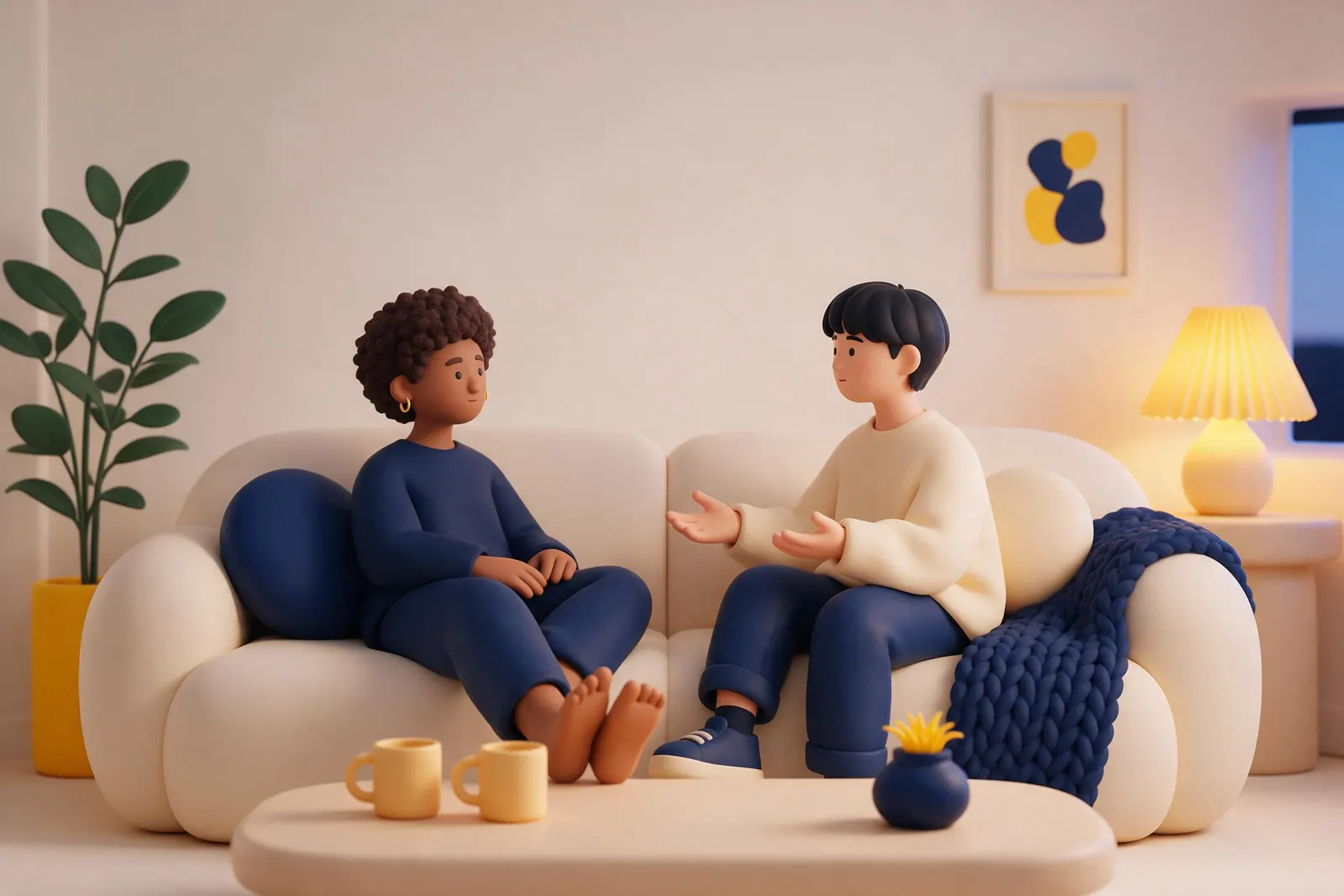 Relationships
Needs, comfort, fights, a partner who’s gone quiet, apologies, big decisions.
How to communicate better with your partner → Friends
 Work & Career
Meetings, feedback, being overlooked, asking for a raise, networking.
Communication in the workplace → Messages & Online
 Everyday Life
New moments added all the time — and you can send in one of your own.
 Reading People
 Conversation Skills
 Speaking Up
 Social Confidence
Free to start. Worth keeping.
- ✓ The first 3 moments in every scene and skill
- ✓ 5 AI coach replies a day
- ✓ Everything in Warm-up, plus:
- ✓ Every moment in all 11 scenes and skills
- ✓ Every new moment we add
- ✓ AI coach on every round — up to 100 a day
- ✓ Everything in Warm-up, plus:
- ✓ Every moment in all 11 scenes and skills
- ✓ Every new moment we add
- ✓ AI coach on every round — up to 100 a day
- ✓ Save ~50% — about $90 a year vs monthly

The best way to communicate better.
Practice the exact moment. Free to start, no card needed.